The ETF Lie: Why Nvidia's Hype Machine Is Masking the Real AI Wealth Transfer

Forget the 4X return promise. The real story behind the Nvidia, AMD, and Micron ETF surge isn't about retail riches—it's about infrastructure dominance.
Key Takeaways
- •The ETF promise masks high concentration risk centered on Nvidia's pricing power.
- •True leverage is shifting towards foundries (like TSMC) and advanced packaging providers, not just chip designers.
- •Geopolitical friction and potential export control tightening present an underestimated risk to the projected growth.
- •Expect market bifurcation: hyperscalers bringing design in-house will pressure merchant silicon margins.
The Hook: The $250K to $1 Million Fantasy vs. The Silicon Reality
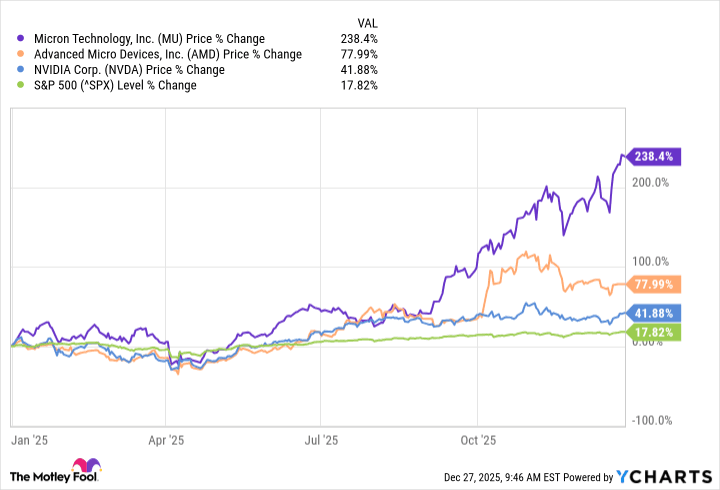
The financial media loves a simple narrative: buy this ETF, ride the AI wave, and retire rich. Publications are breathlessly touting a quadrup le return over ten years, fueled by the 'unstoppable' trinity of Nvidia, AMD, and Micron Technology. This is the story you are being sold. But as investigative journalists, we must ask: Who actually benefits from this widespread retail FOMO? The truth is far more complex than a neat 4X projection.
The core premise relies on sustained, exponential growth in AI chip demand. While Nvidia's H100/B200 dominance is undeniable—they currently command near-monopoly pricing power—the ETF structure itself is the hidden variable. These funds, designed for broad exposure, dilute the explosive upside of the true bottleneck suppliers while simultaneously exposing investors to the inevitable cyclical downturns that plague the semiconductor industry.
The Meat: Beyond the Hype—Who Actually Controls the Bottleneck?
The current excitement centers on the compute layer (GPUs from Nvidia/AMD) and the memory layer (DRAM/HBM from Micron). But the unspoken truth is that the true, durable moat isn't just in the chip design; it's in the advanced semiconductor packaging and the underlying foundry capacity. TSMC, which manufactures the vast majority of these high-end chips, holds a leverage point that dwarfs the consumer-facing branding of the chip designers. Investing in an ETF that merely bundles the chip designers misses the structural shift in supply chain control.
Furthermore, the concentration risk is astronomical. When one stock, like Nvidia, becomes the gravitational center of an entire sector's valuation, any stumble—a regulatory change, a shift in customer CapEx spending (like from Microsoft or Google), or a breakthrough in alternative computing architectures—sends shockwaves through the entire basket. The ETF promises stability; the underlying assets promise volatility driven by a few key earnings calls.
The Why It Matters: The Infrastructure Wars and Geopolitical Risk
This isn't just about stock returns; it's about global infrastructure dominance. Access to cutting-edge AI hardware is becoming a geopolitical asset. The current investment thesis largely ignores the increasing friction caused by export controls and technological decoupling between major global powers. If the market pricing assumes frictionless global distribution of these advanced components, the investors are pricing in a massive, unacknowledged risk. AI chip demand is robust, yes, but the political headwinds are intensifying, threatening the supply chains supporting these semiconductor giants. This vulnerability isn't fully priced into a simple 10-year projection.
What Happens Next? The Prediction: Consolidation or Collapse
We predict that within the next 36 months, the market will bifurcate. Either the major hyperscalers (Amazon, Google, Microsoft) will successfully bring more of their chip design and potentially even packaging in-house, severely eroding the pricing power of merchant silicon providers like Nvidia and AMD, or a massive M&A wave will occur. We believe the former is more likely as companies seek customization and cost control. This will lead to a temporary, sharp correction in the valuations of pure-play component suppliers, shaking the foundations of any ETF built solely on their current growth trajectory. The 4X return will look far more like a 1X return followed by a 50% drawdown.
For genuine long-term exposure, investors need to look beyond the headline names and focus on the foundational enablers of advanced manufacturing, like specialized materials science companies or the tooling providers that service the foundries. That is where the real, less hyped, but more durable wealth creation lies. Read more about the global semiconductor supply chain challenges here: Reuters on Global Tech Supply Chains.
Gallery


Frequently Asked Questions
What is the primary risk of investing in an ETF heavily weighted toward Nvidia, AMD, and Micron?
The primary risk is concentration. If the growth trajectory of these few high-flying stocks falters due to market saturation or unexpected competition, the entire ETF valuation suffers disproportionately, regardless of broader market health.
Are Nvidia's AI chips truly 'unstoppable' in the long term?
While their current dominance is significant, 'unstoppable' is marketing language. Competitors are catching up, and major customers (like Google and Amazon) are increasingly designing custom silicon (ASICs) to reduce reliance on merchant suppliers, posing a long-term threat to pricing power.
What are the key geopolitical risks affecting semiconductor ETFs?
The main geopolitical risk involves trade restrictions and export controls, particularly concerning advanced manufacturing equipment and high-end chips destined for specific international markets. This directly impacts the total addressable market for companies like Nvidia and Micron.
How does advanced packaging relate to the current AI chip boom?
Advanced packaging (like chiplets and 2.5D/3D stacking) is crucial because it allows manufacturers to overcome the physical limits of traditional chip scaling, enabling the high-bandwidth memory (HBM) required for large AI models. It is a critical, often overlooked, bottleneck.
Related News

The Micron Mania Is A Lie: Why This AI Chip Stock Is A Trap, Not a Triple Threat
Forget the triple-digit hype. The real story behind Micron's soaring stock price reveals a dangerous dependence on Big Tech's whims.

The Silent Coup: Why Bourgeon Capital's MRVL Bet Signals a Deep Chip War We Aren't Seeing
Bourgeon Capital's increased Marvell Technology $MRVL stake isn't bullish noise; it's a calculated bet on the next phase of the AI infrastructure arms race.
