The Cosmic Conspiracy: Why Early Universe Black Holes Are Rewriting Physics (And Who Benefits)
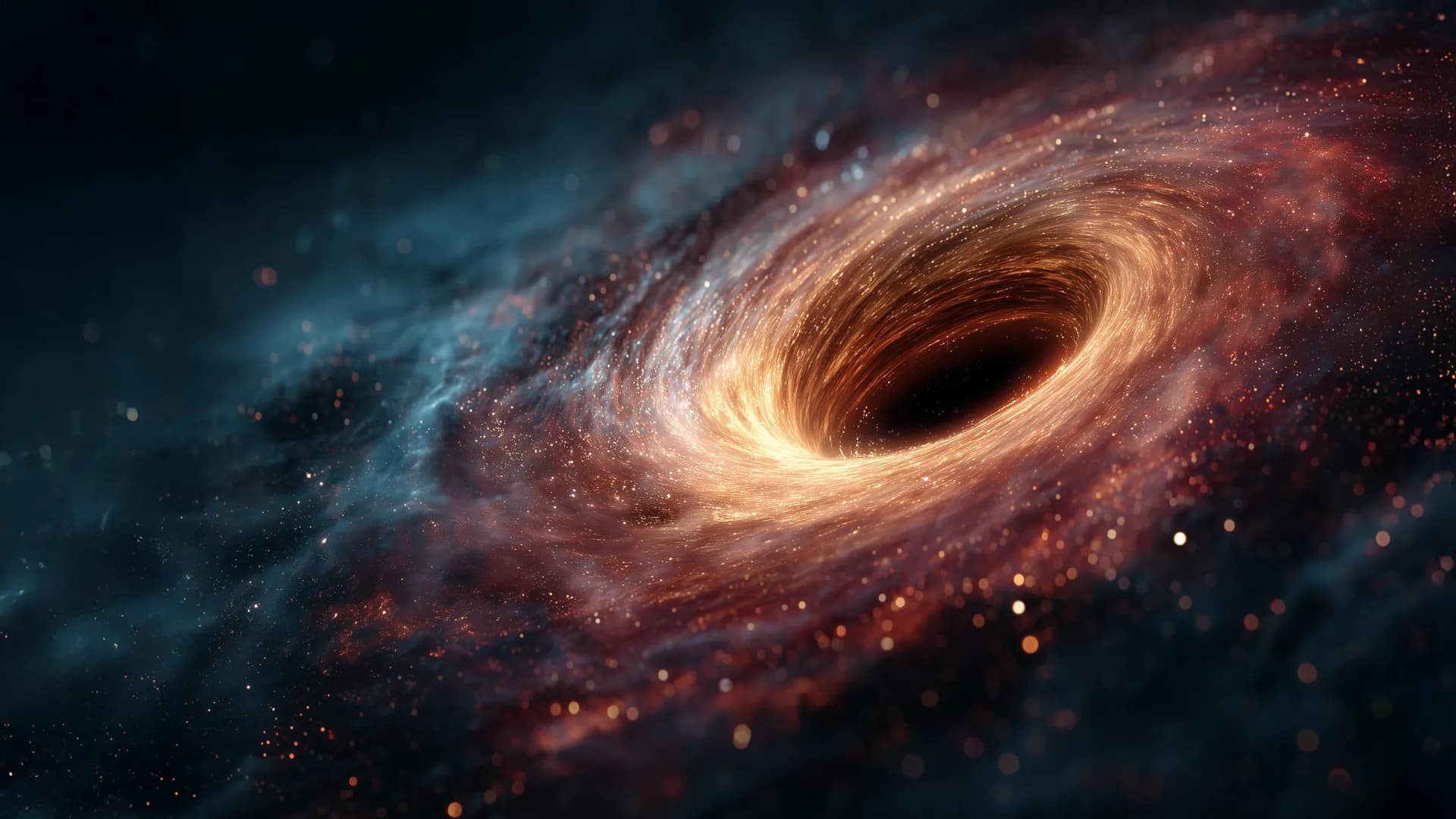
The discovery of supercharged early universe black holes isn't just astronomy; it's an existential crisis for modern cosmology. We dissect the fallout.
Key Takeaways
- •Black holes in the early universe grew faster than the theoretical Eddington Limit allows.
- •This discovery threatens the standard model of gradual cosmic structure formation.
- •The most likely explanation involves 'direct collapse' or exotic physics operating in the universe's infancy.
- •The data indirectly supports models where dark matter dictated the initial formation of these massive seeds.
The Hook: The Universe Is Lying To Us
Forget the slow, stately growth we were taught. New data confirms that **early universe black holes** were absolute monsters, punching far above their weight class just moments after the Big Bang. This isn't just a tweak to the textbooks; it’s a foundational crack in the standard model of cosmology. The prevailing narrative of gradual stellar collapse and accretion is collapsing under the weight of these primordial giants. The key question no one is asking is: **What mechanism allowed this hyper-acceleration?** We’re talking about supermassive black holes existing when the universe was barely a toddler. This forces us to confront the possibility that the seeds of structure were planted by physics far more exotic than we currently allow.The Meat: Analyzing the Accretion Anomaly
The news confirms that the growth rate of these **cosmic behemoths** defied the Eddington Limit—the theoretical maximum speed at which a black hole can feed before radiation pressure blows the surrounding gas away. If they grew faster than the limit allows, something fundamental must have changed the rules of the game in the first billion years. We are forced to entertain scenarios involving 'direct collapse' of massive gas clouds, bypassing stellar evolution entirely, or perhaps, the physics of gravity itself behaves differently under the extreme conditions of the early universe. This challenges the very notion of uniform physical laws across cosmic time. The winners here are the radical theorists, whose fringe models suddenly look like mainstream science. The losers? Anyone invested in maintaining the comfortable, predictable timeline of cosmic evolution.
The Why It Matters: The Hidden Agenda of Dark Matter
Why does this matter beyond star charts? Because these massive structures are the scaffolding of everything we see, including galaxies like our own Milky Way. If the initial seeds were this large, it fundamentally alters our understanding of structure formation. More critically, this phenomenon might be intrinsically linked to **dark matter distribution**. If massive primordial black holes formed directly from collapsing dark matter halos—a controversial theory—then these findings are a massive indirect validation for dark matter physics, even if we still can't detect the particle itself. This pushes the search for answers away from particle accelerators and back into the deep field surveys, where the evidence is literally written in light from the past. It’s a subtle victory for observational astrophysics over purely theoretical modeling.What Happens Next? The Great Contraction of Theory
Expect a rapid consolidation in cosmological theory. We will see a massive influx of funding diverted from searches for 'standard' dark matter particles toward computational models that can rapidly generate these massive initial seeds. My prediction: Within five years, the scientific consensus will shift toward favoring 'heavy seed' formation models, potentially reviving concepts related to 'primordial black holes' formed in the universe’s first second, not just its first billion years. This will inevitably lead to a renewed, aggressive push to detect gravitational waves from these events, as LIGO and VIRGO upgrade. The search for the **early universe black holes** is becoming the new high-stakes game in physics.Key Takeaways (TL;DR)
* Early universe black holes grew impossibly fast, violating known accretion limits. * This implies fundamentally different physics or formation mechanisms in the universe’s infancy. * The findings subtly boost theories linking structure formation directly to dark matter halos. * Expect a major pivot in funding toward modeling and gravitational wave detection.Frequently Asked Questions
What is the Eddington Limit in black hole physics?
The Eddington Limit is the theoretical maximum rate at which a black hole can accrete mass. If it feeds faster, the intense radiation pressure from the incoming material pushes the gas away, halting further rapid growth.
What does 'early universe' mean in this context?
In this context, 'early universe' refers to the first billion years after the Big Bang, a period when the universe was significantly denser and hotter than it is today, allowing for potentially different physical processes.
How do these findings relate to dark matter?
If these massive black holes formed without waiting for stars to die, they might have originated from the direct collapse of dense dark matter halos, providing a major clue about the nature and behavior of dark matter itself.
Are these early black holes a threat to life on Earth?
No. These specific black holes are billions of light-years away and their existence only impacts our understanding of universal history, not our immediate cosmic neighborhood.


DailyWorld Editorial
AI-Assisted, Human-Reviewed
Reviewed By
DailyWorld Editorial