The Silent Victory: Why China's Rocket Recovery Is a Bigger Threat Than Elon Musk Admits

China's successful sea recovery of a rocket booster signals a massive shift in the global space race, challenging Western dominance in reusable technology.
Key Takeaways
- •China's sea recovery is a strategic play for long-term cost control, not just an imitation of US efforts.
- •Maritime recovery capability offers China greater operational flexibility and lower risk profile.
- •This development will exert severe economic pressure on smaller, non-reusable global launch providers.
- •The next critical benchmark will be achieving a sub-90-day turnaround time for re-flight.
The Hook: The Trickle of Progress That Masks a Tidal Wave
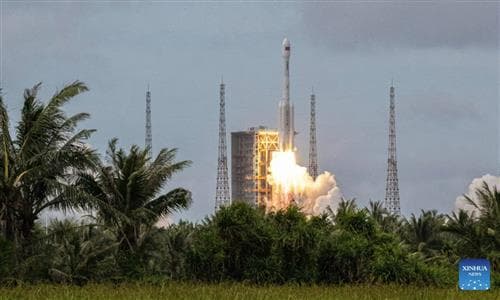
Everyone is focused on SpaceX’s triumphant Falcon 9 landings, but the real geopolitical tremor just hit the Pacific. China has successfully recovered its first orbital-class rocket booster from the sea, a seemingly incremental step that is, in reality, a declaration of intent. This isn't just about saving steel; it’s about fundamentally changing the economics of access to orbit. The narrative pushed by Western media frames this as China playing catch-up. **The unspoken truth is that China is building redundancy, and redundancy beats speed in the long game of space industrialization.**
We must stop viewing this through the lens of the 'Space Race 2.0' nostalgia. This latest achievement in reusable rocket technology isn't an imitation; it's a parallel development track designed for a different economic reality. While the US prioritizes rapid iteration and maximum launch cadence, China is focused on robust, state-backed standardization. Their goal isn't just getting to space; it's establishing an unassailable, cost-controlled infrastructure.
The 'Meat': Analyzing the Cost-Per-Kilo Conundrum
The entire value proposition of reusable rockets hinges on lowering the cost-per-kilogram to orbit. SpaceX achieved this through sheer volume and aggressive vertical integration. China’s approach, evidenced by this recovery, is different. They are leveraging massive, centralized state investment to absorb initial R&D losses, aiming for a long-term, fully recoverable system that can operate regardless of market whims. This is critical for their planned space station expansion and lunar ambitions.
The recovery itself—presumably using naval assets—suggests a focus on maritime recovery over land-based drone ship landings, perhaps optimizing for larger, heavier booster stages or simply diversifying recovery options. This maritime capability is a huge strategic asset, minimizing risk to populated areas and offering greater operational flexibility, a key component of their long-term space technology roadmap.
The 'Why It Matters': The Hidden Losers
Who truly loses when Chinese recovery capabilities mature? The immediate losers are smaller, national launch providers globally who cannot match the economies of scale of either SpaceX or a state-backed enterprise like the China Aerospace Science and Technology Corporation (CASC). If China can offer highly reliable, state-subsidized launch services, the commercial viability of smaller, non-reusable national providers—even in allied nations—evaporates. This is a technological move that doubles as an economic weapon, freezing out competition before it can even take hold. This development fundamentally reshapes the global market for space launch services.
The Prediction: What Happens Next?
Within five years, expect China to not just match, but potentially undercut, the baseline cost-per-kilo of the Falcon 9 for government and allied commercial contracts. The next major milestone won't be another successful sea landing; it will be the first successful *re-flight* of a recovered booster within 90 days. This speed will force NASA and the Pentagon to seriously re-evaluate their reliance on single providers. Furthermore, expect increased international friction over the recovery zones, as both superpowers claim vast swathes of the ocean for their operations, turning the high seas into contested orbital staging grounds.
For more on the economics of orbital access, see the analysis by the European Space Agency on launch vehicle economics [https://www.esa.int/]. The history of rapid technological adoption can be tracked via official government publications like the NASA archives [https://www.nasa.gov/history/].
Gallery


Frequently Asked Questions
What is the primary advantage of recovering a rocket booster at sea?
Sea recovery, particularly using large naval vessels, allows for the recovery of larger or heavier boosters that might otherwise require excessive fuel margins for a land landing. It also avoids potential debris impact zones over populated areas, increasing operational flexibility.
How does China’s approach to reusable rockets differ from SpaceX’s?
SpaceX prioritizes rapid iteration and volume to drive down costs through market competition. China utilizes centralized, state-backed investment to build robust, standardized systems designed for long-term infrastructure goals, often prioritizing reliability and state control over immediate commercial speed.
What is the significance of 'cost-per-kilogram' in the space industry?
Cost-per-kilogram to orbit is the fundamental metric for economic viability in space access. Lowering this cost makes large-scale endeavors like building space stations, lunar bases, and massive satellite constellations financially feasible.
Is this move purely technological or does it have geopolitical implications?
It is deeply geopolitical. Controlling the cost and reliability of access to space grants significant leverage in international relations, scientific collaboration, and future resource utilization, effectively creating a new barrier to entry for other nations.
Related News

The $10 Billion Lie: Why the Rocky Mountain IP Institute Hides the Real Tech War
The annual Rocky Mountain IP Institute convenes, but the real battle for **technology** dominance isn't in the lecture halls—it's in the shadows of **patent litigation**.

The Addiction Lie: Why YouTube's 'Viewer Value' Claim is Just Genius PR for Surveillance Capitalism
YouTube executives preach 'viewer value,' but the real goal of their massive platform is far darker than mere entertainment.

The $7.8 Billion Bet: Why Gilead's Arcellx Buyout Signals the Death of the Solo CAR-T Dream
Gilead's massive $7.8bn acquisition of Arcellx isn't just about pipeline depth; it’s a brutal market consolidation signal in the competitive **biotech M&A** landscape.
